|
Description:
Antique
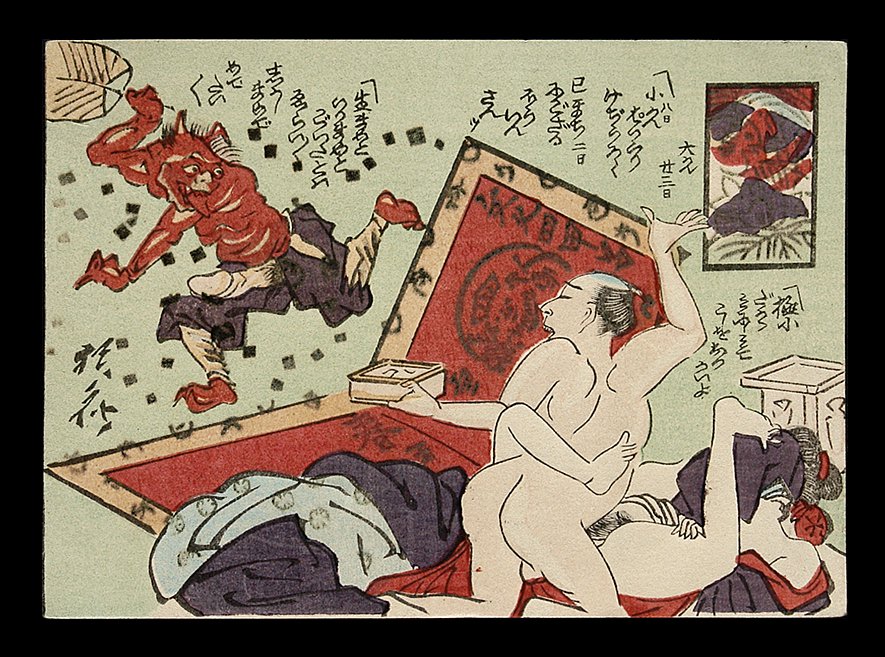
Japanese color woodblock by Kawanabe Kyõsai (1831-1889).
Shunga (Erotic print).
Date: 1870. Koban size: 5" x 3
1/2" inches. Fine impression, color and condition.
Signature: Kyosai
always signed his erotic work (in this case in the below left
corner!).
Series: 'Flower Calendar (Hanagoyomi)'.
Title: 'Lovers in a Carp Streamer - For the Month of May'.
Wonderful printed details such as metallic pigments and
embossing.
On this design:
"...A familiar subject in
Kyõsai's oeuvre is Shõki the demon queller chasing a demon
(oni). One of his finest 'Shoki' compositions is a
painting housed in the collection of the Linden-Museum
Stuttgart which shows the demon queller following an oni,
who is hiding in the mouth of a paper carp streamer (koinobori).
In a shunga version of this theme Kyõsai also depicts
Shõki in pursuit of the demon, but in a comic twist the oni
has been replaced by a couple making love (cat. no. 88a).
This small koban-size print is from a series of
twelve images entitled 'Flower Calendar (Hanagoyomi)'
, in which each sheet represents one of the twelve months
and includes text by an unidentified author. The association
of the carp streamer with the Boy's Festival on the fifth
day of the fifth lunar month (May) and the fact that Shõki
is known as a guardian of children are the first clues that
this composition is linked to May.
Additional hints lie in the dialogue
inscribed on the sliding door and the wall in the
background. It begins to the far right with the man
exclaiming 'Good, good, superb!' (yokutte, yokutte,
kotaerarenehe) and includes the number five and the
character dai (long). This indicates that the print
was published in 1870, a year when May was a 'long' month
(30 days, a 'short' month is 29 days). The young woman then
tells the man to wait. He asks why, and his words are
followed by the number thirty. This is an allusion to the
'Blue Warrior Festival' (Kõshinmachi), which in 1870 took
place on the thirtieth day of May. The man explains that he
finds the carp streamer a cosy place to make love. But the
woman repeats that he should wait, using the expression 'han-goshõ'
(goshõ means 'pardon me'; han or 'half' was
added for the sake of punning) and the number twenty-nine.
In 1870, the twenty-ninth day of May marked mid-year (han-geshõ),
or more precisley the eleventh day after the summer
solstice, and the author creates a wordplay with the terms han-goshõ
and han-geshõ. The final words of the couple,
integrating the number three, state that they do not like
the rainy season. This is another allusion to May, as the
beginning of the rainy season (nyûbai) fell on the
third day of the month". (excerpt from the article 'Meiji
Shunga: The Comic Genius of Kawanabe Kyõsai ' by Oikawa
Shigeru)
Reference:
Ill.88a on p.219 in 'Japanese Erotic Fantasies' by C.
Uhlenbeck and M. Winkel.
Kyõsai is one of the greatest shunga
masters and his erotic work is rarely seen on the art market
!
|