Shunga
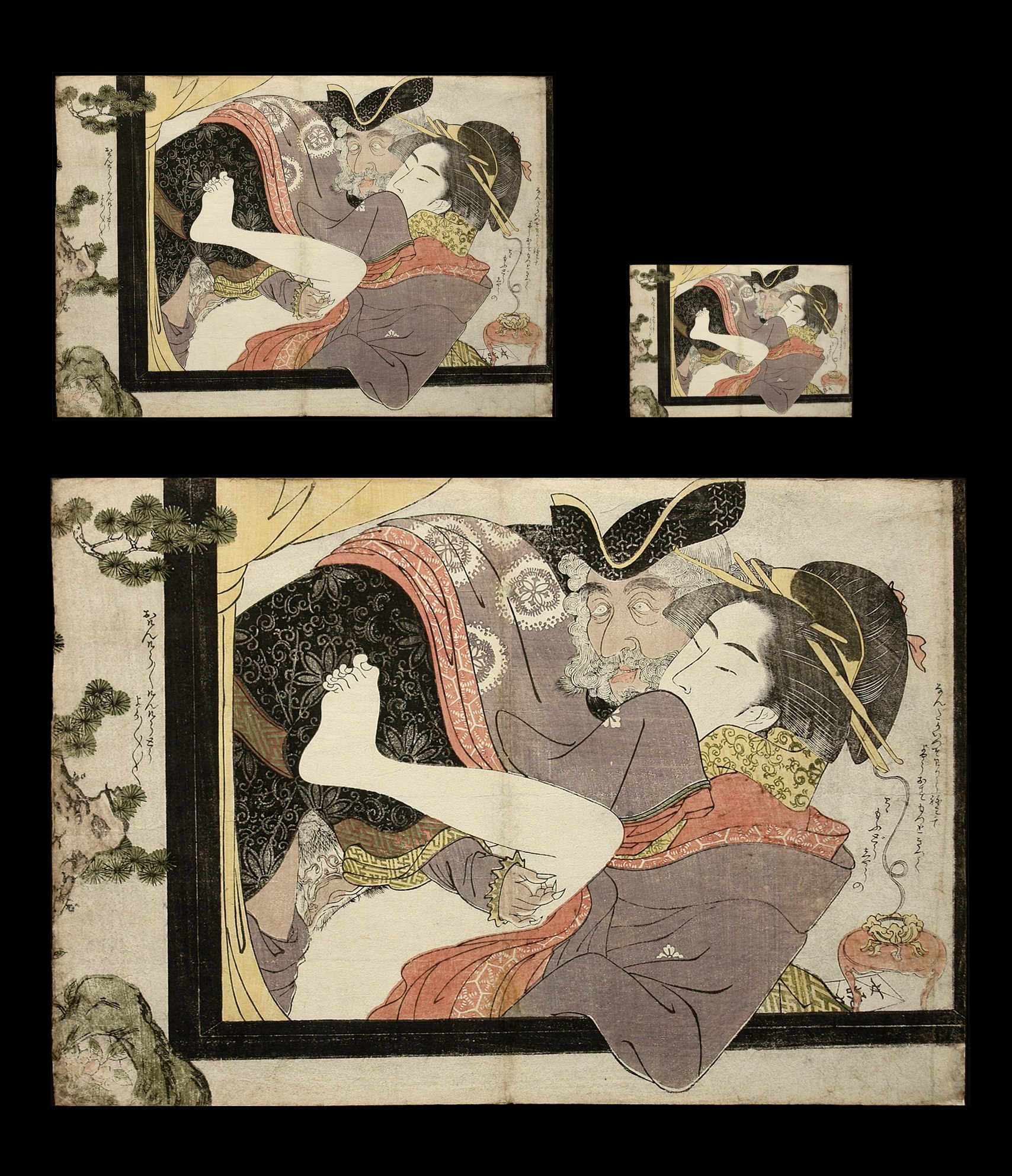
Masterpiece - Chõkyõsai Eiri – Dutch Captain –
Dutchman
With Prostitute – c.1801.
Original antique Japanese color
woodblock print by Chõkyõai Eiri (act. 1789-1801). Shunga
(Erotic print).
Date: New Year 1801. Oban yoko-e size: 14
1/4” x 9 4/5” inches. Series: 'Models of Calligraphy
(Fumi no kiyogaki)‘.
Fine impression, very good
color and condition. Some minor wear and soiling, marks and
flaws. Virtually full size.
Wonderful use of metallic pigment
details.
“Through the window of a
brothel in Nagasaki we spy a Dutch captain having sex with a
Japanese courtesan. Incense burns in a vessel on the small
table to the right, and below it is a small paper sachet which
contains an aphrodisiac for women called nyõetsugan.
The Dutchman’s long cat-like fingernails are a striking
detail.
Dutch women were not permitted
to live at the Dutch trading post on Dejima island near
Nagasaki, but Japanese prostitutes were allowed entry to the
compound. These Japanese women were known as Oranda-yuki
(‘those going to the Dutch’), as opposed to the Kara-yuki
(‘those going to the Chinese’) and the Nihon-yuki (‘those
going to the Japanese’). In theory, the Dutch were forbidden
to leave Dejima, even though exceptions were made for sexual
entertainment. They frequented the Maruyama, Nagasaki’s
licensed pleasure quarter (Vos 1971: 618). Vos cites various senryu
poems to demonstrate the role the Maruyama played in the lives
of the Dutchmen, so far away from their homeland:
Love at Maruyama
Bridges a distance of thirteen thousand miles
(Vos 1971: 622).”
(Excerpts from the book ‘Japanese
Erotic Fantasies, Sexual Imagery of the Edo Period’ by
Chris Uhlenbeck...etc.)
|
More
comments on this design:
|
“...This page is from a
folding album of thirteen images (unusual, as one dozen is the
norm) attributed to Chõkyõsai Eiri, a little-known pupil of
Hosodai Eishi (1756-1829). Eishi was a military-class
(samurai) artist who began his painting career in the
government-sponsored Kano school, but left in about 1785 to
work in the popular ‘floating-world’, or ukiyo-e, style
(cats 56, 57, 87, 117). Thereafter, Eishi was rival for
paramount fame with Utamaro, though Eishi had the greater
number of pupils. Interestingly, in 1800, just months before
the image shown here was published, a painting by Eishi was
shown to retired monarch Go-Sakuramachi (1740-1813; r.
1762-70), allowing his use of the coveted title ‘Viewed by
Heaven’ (tenran)...[...]
[...]...The scene shows a
well-dressed European, surely intended to be a senior Dutch
trader, with a Japanse woman, who would be a Nagasaki
courtesan. They are both heavily dressed for winter, but she
leans out of an open Western-style window, suggesting that
they are in the East India Company compound on the island of
Dejima (which, of course, Eiri would never have seen). It is
elegantly fragranced with burning incense. The European speaks
gibberish, while the woman protests, “I can’t make out
what you’re on about. Push it in tighter! What am I to do?’
“. (Timon Screech – Head of the Japanese Section in the
Department of Asia at the British Museum, London)
“...Eiri’s album opens with
one of the most exotic scenes in all shunga. A Dutch kapitan
is discovered coupling with a lovely Japanese courtesan,
beside a large window opening upon a garden – aphrodisiac
incense shown burning languorously at right. The reader of
this volume probably does not need to be told that, during
most of the Edo Period (1600-1868), the only Occidentals
permitted in Japan were the Dutch emissaries and traders –
who were restricted to a specially-built island in Nagasaki
Bay. Their wives and women were not permitted; but Japanese
harlots and courtesans had relatively free access, so this was
not exactly a hardship post. Only befittingly for a major
seaport, Nagasaki had long been famed for its Maruyama
licensed-quarter, one of the largest in West Japan. Thus it
was only natural that a special “delivery service” should
have been provided for the lonely Dutchmen; and as is
manifestly the case in the present scene, the girls often
learned to delight in consort with the exotic foreigners.”
(Richard Lane)
“...During the long
journey from Dejima before finally reaching the artists, tales
about foreigners became much exaggerated. The resulting
images, thus based on rumours and imagination, usually
depicted the ‘barbarians’ in a frightening light, as
filthy, with strange habits and long beards, and sometimes
with fingernails resembling the talons of birds of prey.” (Ofer
Shagan)
“...The album opens with an
image showing a Dutchman and a Japanese courtesan making love,
framed by a window opening on to a garden. The design
perfectly expresses the violent contrast between the delicate
image of the Japanese young woman and the repulsive Dutchman
– a ‘Southern barbarian’, according to the next. Utamaro’s
Poem of the Pillow, on the other hand, closes with the
image of a grotesque Dutch couple, depicted clutching each
other in a ridiculous sexual embrace.” (Gian Carlo Calza)
| References:
|
p.146
(Ill.49a) in ‘Japanese Erotic Fantasies, Sexual Imagery
of the Edo Period’ by Chris Uhlenbeck
|
|
p.345
(Ill.4) in ‘Japanese Erotic Art, The Hidden
World of Shunga’ by Ofer Shagan
|
|
p.237
(Ill.6.75) in ‘Shunga, the Art of Love in Japan’
by Tom and Mary Evans
|
|
p.327
(top) in ‘Poem of the Pillow and Other Stories
by Utamaro...etc.’ by Gian Carlo Calza
|
|
p.400/401
(Ill.119) in ‘Shunga, Sex and Pleasure in Japanese Art’ by
Timothy Clark
|
|
p.12-31;
Hayashi and Lane 1995-2000, Vol.9; Hayashi and Lane 1995-2000,
suppl. Vol.1, p.124-6, No.200
|
|
p.327-8;
Buckland 2010
|
|
p.110-12,
Screech 2009, No.122
|
>>
Here
you can check out an article on Westerners portrayed in
shunga.
This
print has been included in the collections of countless
museums such as the
>>
British Museum
and
The Metropolitan Museum of Art !
One of
the Great Masterpieces of Shunga !


 Click
on the Picture.
Click
on the Picture.