Description:
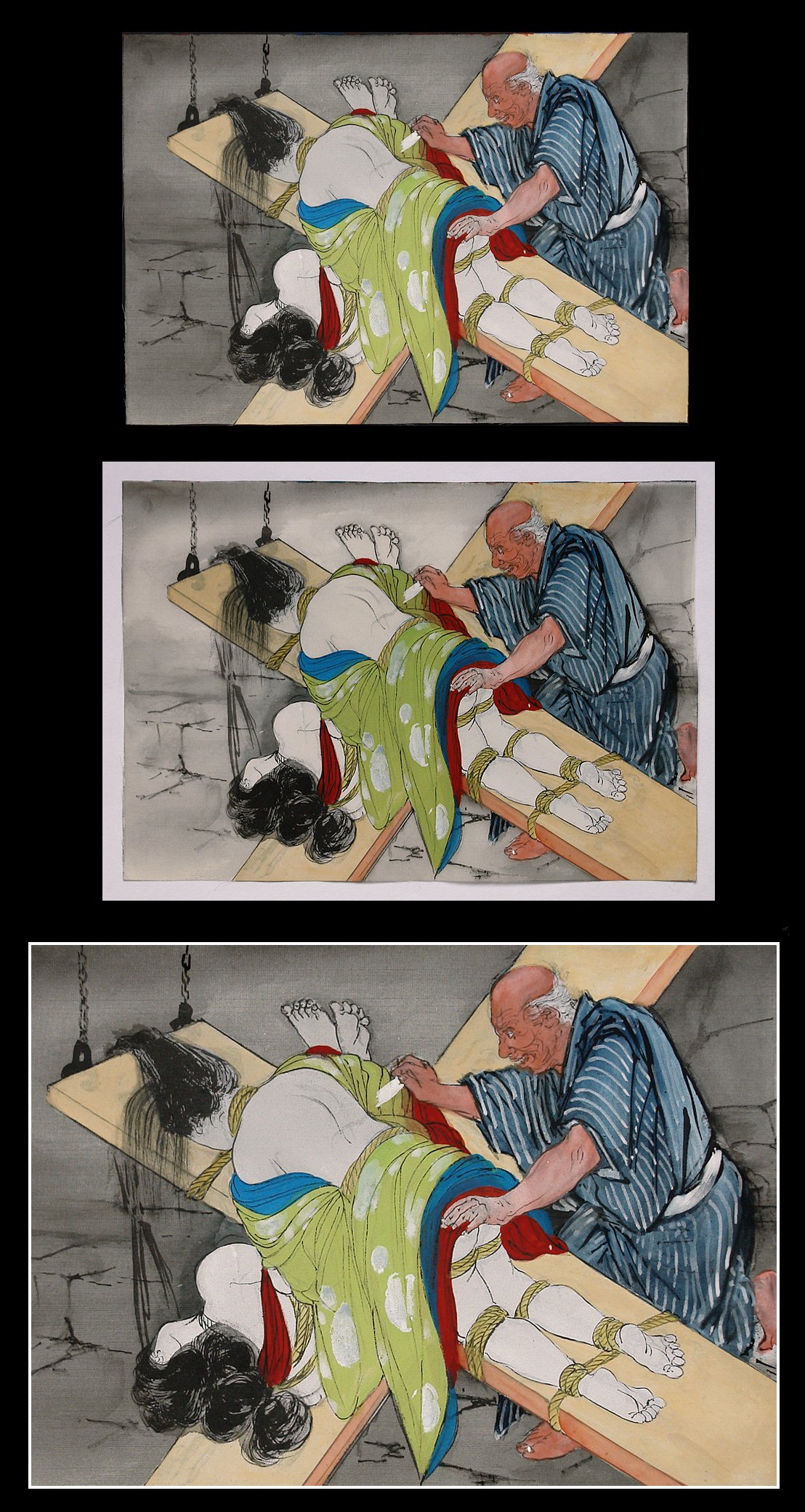
Japanese erotic painting
on silk by Ito Seiu (1882-1961). Ink and colour on silk. Date:
c.1940s.
Size: 11 1/5" x 7 2/3" inches. Wonderfully detailed piece with fine colors and in a fine condition.
The work comes with a signed certificate of authenticity.
A forceful and
intriguing image from the "father of Kinbaku" portraying
an older man ( most probably Ito himself )
torturing two binded woman
who are lying crosswise on top of each other.
Ito Seiu was a
Japanese-style painter/ photographer from Tokyo, who studied at the
Rimpa School under Nozawa Teiu.
While he worked as an illustrator of
newspapers, he was also known as a genre painter depicting mainly
sado-erotic
themes and ghosts. ( see more info below! )
|
Ito
Seiu - Rare Sado Erotic Painting -
Kinbaku
- Bondage - 1940s.
|
|
|
|
 Click
on te Picture.
Click
on te Picture.
|
|
Ito Seiu's work is very
seldomly seen on the art market !
Biography
>
Ito
Seiu
In the history of
Sado-Masochism in Japan, there's one man who stands out for creating
a solid basis for the SM genre as an art form. Ito Hajime
(1882-1961), son of a sculptor, was born in the Asakusa, a working
class district in Tokyo. At the age of 10 he visited a kabuki drama
presenting a samurai heroine which awoke his passion for females in
distress.
When Ito was 13 he
adopted the name Seiu (kanji for words 'clear' and 'rain') at age 13
and had several odd jobs varying from printer's apprentice to
newspaper reporter. But his attraction to women in distress
never diminished. At the age of 34, he
started to draw and paint 'Seme- e'
( torture pictures ) using
a model named Oyo who would later become a fiancée of Yumeji
Takehisa (a well-known Taisho era artist).
In the spring of 1919,
Ito hired a young art school model named Sahara Kise.
They were soon living together, and after she became pregnant
Kise became his second wife. She posed
freely for her husband, and he started to use his young consort as a
model for his 'restraint' experiments as portrayed in the old
Ukiyo-e prints, photographing her nude or semiclad body in sessions
that lasted as long as three hours. He
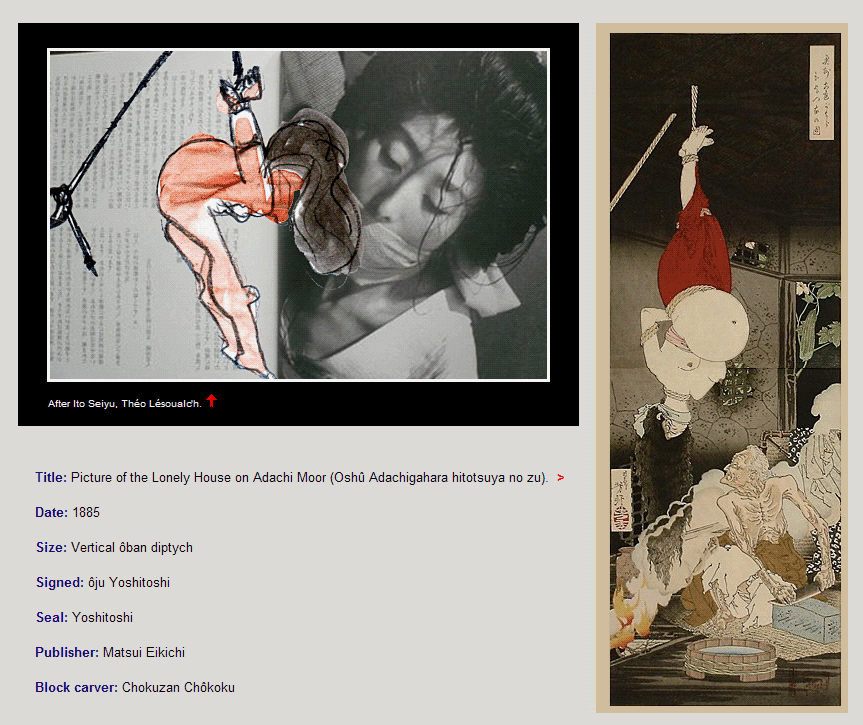
once even went so far as to hang her down while pregnant in order to
recreate Yoshitoshi's well-known and shocking Lonely House
-diptych ( see info below ! ).
Due to Ito's attempts to
bring back to life, refresh and promote shibari (bondage) art
he achieved national recognition, and with it, renewed reputability.
In 1924 he was featured in an issue of Sunday Mainichi, a
mainstream magazine spread nationwide, while tying up and
photographing his wife in various poses. After this article was
treated in a column of The Japan Times and Mail, a devoted
rope maker wrote a letter to the newspaper complaining about the
abuse of hemp in the name of art.
Ito's fortunes declined
when censors embraced a strict approach to art in the 1930s. He
became almost bankrupt after paying medical bills for his third
wife, who was affected by a mental illness, and lost a majority of
his works during the Great Tokyo Air Raid in 1944.
Already 63 when the war
ended, he nevertheless demonstrated a refreshed energy, taking
advantage of postwar liberalization he produced a large quantity of
illustrated books, prints, makimono (scrolls), pocket-size
books, postcards and photo collections. His works varied from the
plainly sexual to the reallly bizarre. Ito's exploring efforts were
joined by other artists and writers who were embracing his revealed
themes.
In 1977 (16 years after
Ito's death) director Noboru Tanaka concluded his Showa era trilogy
with the movie Beauty's Exotic Dance:
Torture! which was
loosely based on >
Ito
Seiu's life.
Quotes:
"The only
recognition I ever received, as a person who has studied bondage
since 1908, was the pervert tag" said Ito Seiu in an article
published in Amatoria magazine in 1953. Ito commonly
acknowledged as the father of modern shibari was an artist of
great skill and influence. A driven, forceful, man he was devoted to
the study of what he called "beauty in suffering". To
satisfy his strong interest he produced many pictures of rope
bondage, both paintings and photographs, in the beginning of the
20th Century. Ito also produced drawings based on historical records
of judicial torture, or shikei (private punishment), and from
well-known legends and myths of females in distress.
Ito, clearly was not an
admirer of the "secure, prudent, accepted" credo, but he
was a fine artist who had a profound impact on the direction of SM
movement in Japan. When he spoke the above quoted words post war
pulp magazines were transforming themselves into mass market erotic
journals and many of Ito's pictures were widely seen." (p.31 in
Secret Magazine Issue No 20, by Master "K")
Literature:
#
Geijutsu Shincho,
Maboroshi no seme eshi: Ito Seiu (The Illusionary Torture Artist:
Ito Seiu). April 1995 (Vol. 46, No.4). Pages 3-67.
#
Nihon keibatsu fuzoku
toshi (An Illustrated Popular History of Crime and Punishment in
Japan), by Ito Seiu and Fujisawa Morihiko,
published 1946-1952 (Reissued by admirers of Ito Seiu
after his death in a single hardbound volume, originally 3 volumes).
#
Utsukushi Dansu, Ito
Seiu (published by Yudachi Inc.), 1997, Japan.
#
Semee no onna, by Ito
Seiu. Published by Photo Musee (1996).
#
Fuzoku Yashi, by Seiu
Ito, 1931.